Plastic Manufacturing Guide
Plastic Extrusion Process: Process Flow, Materials and Production Controls
A comprehensive guide to the plastic extrusion process covering process flow, die design, melt flow, cooling methods, profile/pipe/film control, common defects, and how extrusio...
Plastic extrusion is a continuous manufacturing process used to produce products with a consistent cross-section, including pipe, tubing, profiles, sheet, film, rod, seals and cable coverings. Thermoplastic material is fed into an extruder, heated and mixed by a rotating screw, forced through a shaping die, cooled, sized and then cut or wound into the required finished form.
This guide explains the complete plastic extrusion process flow, the function of each line component, die-design principles, cooling and calibration methods, material selection, important process variables, common defects and quality-control requirements. It is intended for engineers and buyers evaluating a custom extrusion project or troubleshooting an existing product.
What Is the Plastic Extrusion Process?
Plastic extrusion converts pellets, powder, granules or a prepared compound into a continuous product. Material enters the feed throat, moves forward through a heated barrel, melts through a combination of external heat and mechanical shear, and becomes a controlled, homogeneous melt. The screw then develops enough pressure to push the melt through a die that forms the required cross-section.
The product leaving the die is still hot and dimensionally unstable. Calibration and cooling equipment hold or guide the extrudate until it can maintain its shape. A haul-off unit controls line speed, after which the product is cut to length, coiled, wound or transferred to additional finishing operations.
Because extrusion runs continuously, it is efficient for long products and large repeat quantities. Its main geometric limitation is that the basic cross-section must remain consistent along the length, although cutting, drilling, punching, printing, bending, welding and assembly can add features after extrusion.
Plastic Extrusion Process Flow
A typical extrusion line includes material handling, feeding, plasticizing, filtration, die shaping, calibration, cooling, pulling and finishing. The exact layout changes for pipe, profiles, sheet, cast film, blown film and coated products.
1. Raw Material Preparation
Base resin may be blended with color concentrate, heat stabilizers, UV additives, impact modifiers, lubricants, fillers, flame modifiers or processing aids. Consistent dosing is important because small formulation changes can affect melt viscosity, dimensions, color and finished performance.
Some polymers absorb moisture and require controlled drying before extrusion. Insufficient drying can cause bubbles, surface streaks, loss of properties or unstable output. Material storage, dryer settings, conveying conditions and regrind percentage should be documented.
2. Feeding and Dosing
A hopper supplies material to the extruder. Volumetric feeders meter material by volume, while gravimetric systems measure weight and can provide tighter control when several ingredients or precise output rates are required. Poor feeding can cause output surging, inconsistent color and dimensional variation.
3. Conveying, Melting and Mixing
The rotating screw carries material through the barrel. A conventional single-screw design includes feed, transition and metering functions, although modern screws may contain mixing sections, barrier features or application-specific geometry. Barrel heaters help establish the temperature profile, while friction and shear generated by the screw contribute substantial process heat.
The objective is not simply to reach a temperature setpoint. The extruder must deliver a homogeneous melt with stable temperature, composition and pressure. Excessive shear can degrade the polymer, while inadequate melting can leave unmelted particles and produce a rough or weak product.
4. Filtration and Melt-Pressure Control
Many lines use a screen pack and breaker plate before the die. Screens filter contamination and help establish a controlled pressure condition. A manual or automatic screen changer may be used when long production runs require filtration without extended shutdowns.
A melt pump can be added when highly stable output and pressure are required. The pump meters the melt to the die and reduces the effect of normal screw-output variation, which can improve thickness consistency in sheet, film and precision profiles.
5. Die Shaping
The die distributes the polymer melt and forms the initial cross-section. Its internal flow channels must deliver material uniformly without excessive residence time, pressure loss or shear. The opening is not always identical to the finished product because the material can swell, shrink, stretch or distort between the die and final calibration.
6. Calibration and Cooling
The hot extrudate must be cooled while its critical dimensions are controlled. Pipe and rigid profiles commonly use vacuum calibration and water cooling. Sheet may pass through temperature-controlled roll stacks. Blown film uses controlled air to cool and stabilize the bubble. The cooling method must remove heat evenly without marking or distorting the surface.
7. Haul-Off, Cutting and Winding
A belt, caterpillar, nip-roll or other puller moves the product at a controlled line speed. The relationship between extruder output and haul-off speed directly affects dimensions. Excessive pull can reduce thickness or distort the profile; insufficient pull can produce oversized dimensions, sagging or surface variation.
Rigid products are typically cut to length with a saw, knife or traveling cutter. Flexible tube, film, seals and small profiles may be wound onto reels. Printing, punching, drilling, surface treatment or automated inspection can be integrated before final packing.
Main Components of a Plastic Extrusion Line
| Line Component | Main Function | Important Control Points |
|---|---|---|
| Material handling and dryer | Stores, conveys and conditions raw material | Moisture, contamination, residence time and regrind ratio |
| Feeder | Meters resin and additives into the extruder | Feed accuracy, blend consistency and flow stability |
| Extruder screw and barrel | Conveys, melts, mixes and pressurizes the polymer | Screw speed, temperature profile, motor load, wear and output stability |
| Screen pack or screen changer | Filters contamination and conditions the melt flow | Pressure increase, filtration level and change frequency |
| Melt pump | Meters stable melt flow to the die when required | Inlet pressure, speed, temperature and sealing |
| Die | Distributes the melt and creates the cross-section | Flow balance, pressure, temperature, die swell and surface condition |
| Calibrator or roll stack | Controls initial dimensions and surface | Vacuum, alignment, temperature and contact pressure |
| Cooling system | Removes heat and stabilizes the product | Water or air temperature, flow, cleanliness and cooling uniformity |
| Haul-off | Pulls the product through the line | Speed stability, grip pressure, alignment and synchronization |
| Cutter or winder | Produces the specified length or roll format | Length accuracy, cut quality, tension and roll alignment |
Single-Screw vs. Twin-Screw Extrusion
Single-screw extruders are widely used to produce pipe, film, sheet, tubing and profiles from prepared thermoplastic material. They offer continuous pumping, plasticizing and melt-pressure generation with relatively straightforward operation.
Twin-screw extruders use two screws and are often selected when stronger mixing, compounding, devolatilization or controlled powder feeding is needed. Screws may rotate in the same or opposite directions depending on the application. Twin-screw systems are common in compounding lines and in certain PVC profile and pipe processes.
The correct configuration depends on the resin form, additive package, output requirement, shear sensitivity, mixing requirement and finished product. Screw diameter alone does not define capacity or product quality; the complete screw design and line configuration must be considered.
Plastic Extrusion Die Design
Die design controls flow distribution, pressure, surface quality and the initial geometry of the extrudate. A successful die must account for polymer viscosity, temperature sensitivity, output rate, wall-thickness distribution and the downstream sizing method.
- Annular dies: create pipe, tubing and blown-film structures around a central mandrel.
- Flat or coat-hanger dies: distribute melt across the width of sheet and cast film.
- Profile dies: produce open or closed custom cross-sections with balanced flow to thick and thin regions.
- Crosshead dies: apply insulation, jackets or coatings around wire, cable, tubing or another continuous substrate.
- Co-extrusion dies: combine two or more compatible material streams into a multilayer or multi-material product.
Die swell occurs when the polymer relaxes after leaving the die and the extrudate becomes larger than the opening in one or more directions. Drawdown from the haul-off can produce the opposite effect. Die design, land length, line speed and calibration are adjusted together to achieve the final dimensions.
Our custom plastic extrusion services support tubes, profiles, channels and other continuous products from drawing review through die development, sample approval and repeat production.
Cooling and Calibration Methods
| Product Type | Typical Sizing Method | Typical Cooling Method | Main Quality Focus |
|---|---|---|---|
| Pipe and tubing | Vacuum sizing sleeve or internal pressure control | Water spray or immersion tanks | Outer diameter, inner diameter, ovality and wall thickness |
| Rigid profile | Dry or wet vacuum calibration tooling | Water tanks or controlled spray cooling | Contour, straightness, twist and surface marks |
| Sheet | Polished roll stack | Temperature-controlled rolls | Thickness, flatness, gloss and roll release |
| Cast film | Chill-roll contact and controlled winding | Chilled roll surface | Gauge uniformity, clarity and winding quality |
| Blown film | Air ring and bubble control | External or internal air cooling | Bubble stability, layflat width and thickness profile |
| Flexible profile or seal | Guides or light calibration | Air or water cooling | Shape retention, stretch and coil consistency |
Cooling must be fast enough to maintain output but uniform enough to avoid residual stress, warpage and surface distortion. Large or thick sections retain heat longer than thin sections, which can cause uneven shrinkage. Water temperature, flow rate, tank length, vacuum and line speed must therefore be balanced for the product.
Common Types of Plastic Extrusion
Pipe and Tubing Extrusion
Pipe and tubing lines use an annular die, sizing equipment, one or more cooling tanks, a haul-off and a cutter or coiler. Critical requirements can include diameter, wall thickness, ovality, pressure performance, surface finish and coil behavior.
Profile Extrusion
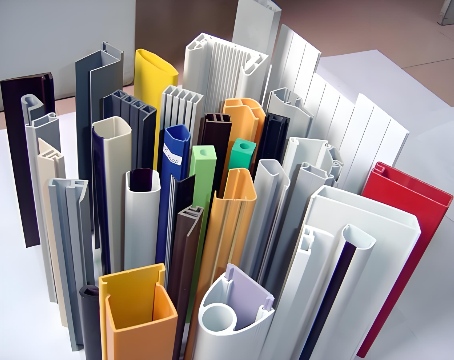
Profile extrusion produces channels, rails, frames, trim, seals and custom open or closed cross-sections. Complex profiles may contain several wall thicknesses and internal chambers, making die balance and calibration especially important. Secondary punching, drilling, printing, cutting and assembly can be added after the profile is cooled.
Sheet and Film Extrusion
Sheet and cast film pass through a flat die and are cooled on controlled rolls. Roll temperature, gap, speed and surface condition influence thickness, flatness, clarity and gloss. Blown film uses an annular die to form a tube that is inflated, cooled, collapsed and wound.
Co-Extrusion
Co-extrusion combines multiple melt streams in one die to create layers or distinct functional regions. It can add a weather-resistant outer layer, soft sealing section, barrier layer, recycled core or decorative surface while maintaining the required base structure.
Material compatibility, melt temperature, viscosity, adhesion and layer distribution must be reviewed together. Our plastic co-extrusion service supports multilayer and multi-material profiles for functional product requirements.
Materials Used in Plastic Extrusion
| Material Family | Common Extruded Products | Important Processing Considerations |
|---|---|---|
| Polyethylene, including LDPE and HDPE | Film, pipe, tubing, sheet and profiles | Cooling, shrinkage, die swell and surface control |
| Polypropylene | Sheet, film, pipe, profiles and fibers | Temperature control, shrinkage and orientation |
| PVC | Pipe, profiles, tubing, sheet and cable compounds | Heat stability, shear, residence time and compound formulation |
| ABS | Profiles, sheet, edging and decorative components | Drying, melt uniformity and surface appearance |
| Polystyrene and HIPS | Sheet, packaging profiles and display components | Temperature, brittleness, orientation and surface quality |
| Polycarbonate | Transparent sheet, glazing profiles and technical tubing | Drying, melt temperature and scratch protection |
| PET and PETG | Sheet, film, strapping and transparent profiles | Moisture control, drying and thermal history |
| Nylon | Tubing, rod, profiles and monofilament | Drying, cooling, crystallization and dimensional control |
| TPE and TPU | Flexible seals, tubing, belts and protective profiles | Moisture, melt stability, tack and haul-off control |
Material selection must be based on the required stiffness, flexibility, temperature range, impact, chemical exposure, weather resistance, transparency, flame rating and regulatory requirements. The specified grade must also be suitable for extrusion; a resin designed for injection molding may not provide the melt strength or flow behavior required for a stable extrusion line.
For tube, film and sheet manufacturing options, see our plastic tube, film and sheet extrusion services.
Important Plastic Extrusion Process Parameters
- Material moisture: affects bubbles, surface appearance, molecular degradation and finished properties for moisture-sensitive polymers.
- Feed rate: controls material supply and influences output stability, mixing and additive consistency.
- Screw speed: changes output, shear heating, mixing, residence time and motor load.
- Barrel-temperature profile: supports controlled melting but does not by itself define actual melt temperature.
- Melt temperature: influences viscosity, surface finish, die swell, cooling demand and material degradation.
- Melt pressure: provides information about screens, flow restrictions, viscosity and process stability.
- Haul-off speed: works with extruder output to determine wall thickness and product dimensions.
- Vacuum level: controls contact between the hot product and calibration tooling for pipe and rigid profiles.
- Cooling temperature and flow: affect line speed, shrinkage, residual stress, straightness and surface condition.
- Winding tension: affects roll shape, stretching, blocking and dimensional stability for flexible products.
Stable extrusion depends on the interaction between these variables. Changing one setting can affect several downstream conditions. For example, increasing screw speed may raise output but also increase shear heat, melt pressure and cooling demand.
Common Plastic Extrusion Defects
| Defect | Possible Causes | Items to Review |
|---|---|---|
| Output surging | Inconsistent feeding, screw instability, poor melting or pressure fluctuation | Feeder, feed throat, screw condition, material consistency and pressure trend |
| Die lines or surface streaks | Damaged die surface, contamination, degraded material or deposits | Die cleaning, filtration, material condition and temperature history |
| Melt fracture or rough surface | Excessive shear stress, high output or unsuitable die conditions | Output rate, die geometry, melt temperature and processing aid |
| Bubbles or voids | Moisture, trapped air, volatile contamination or thermal degradation | Drying, venting, temperature profile, material handling and regrind |
| Wall-thickness variation | Unbalanced die flow, mandrel misalignment, output variation or unstable puller speed | Die centering, melt pressure, haul-off synchronization and online gauge data |
| Warpage, bow or twist | Uneven cooling, unbalanced profile geometry or calibration misalignment | Cooling distribution, calibrator alignment, die balance and line support |
| Discoloration or black specks | Excessive heat, long residence time, contamination or material degradation | Temperature, dead spots, shutdown procedure, purge method and equipment cleanliness |
| Unstable dimensions | Changes in output, haul-off, vacuum, cooling or material lot | Recorded process trends, calibration, raw material and measurement frequency |
| Poor layer adhesion in co-extrusion | Material incompatibility, contamination or unsuitable melt-temperature balance | Material pairing, surface condition, layer temperature and die design |
Troubleshooting should begin with recorded process data rather than several simultaneous setting changes. Confirm when the defect started, whether it follows a material change, and whether melt pressure, temperature, motor load, line speed or cooling conditions changed at the same time.
Plastic Extrusion Quality Control
A quality plan should connect product requirements to measurable process and inspection controls. The most important checks depend on the product, but a typical extrusion plan includes:
- Verification of resin grade, additive package, color and approved regrind percentage.
- Material moisture or other incoming-condition checks where required.
- Monitoring of feeder rate, screw speed, motor load, melt temperature and melt pressure.
- Control of vacuum, cooling temperature, haul-off speed and winding tension.
- Online measurement of diameter, wall thickness, width or overall profile dimensions when appropriate.
- Scheduled dimensional checks using gauges, calipers, micrometers, optical systems or profile fixtures.
- Surface inspection for scratches, die lines, bubbles, contamination, discoloration and gloss variation.
- Mechanical, impact, pressure, leak, chemical, flame or weathering tests when required by the application.
- Length, coil, roll, labeling, traceability and packaging verification.
Statistical process control can identify gradual dimensional movement before the product exceeds tolerance. Trend data is especially useful for long production runs because tool temperature, screen pressure, raw material and cooling conditions can change over time.
Plastic Extrusion vs. Other Manufacturing Methods
| Factor | Extrusion | Injection Molding | Thermoforming | CNC Machining |
|---|---|---|---|---|
| Basic product geometry | Continuous constant cross-section | Separate complex three-dimensional parts | Large formed sheet components | Custom geometry cut from stock |
| Typical tooling | Die, calibrator and downstream tooling | Closed production mold | Forming tool and trim fixture | Standard cutting tools and fixtures |
| Production style | Continuous | Cyclic | Cyclic sheet forming | Subtractive batch production |
| Best fit | Pipe, tubing, profiles, sheet and film | Repeat parts with ribs, bosses and detailed features | Large covers, trays, liners and panels | Prototypes and precision low-volume parts |
| Main design limitation | Cross-section remains consistent along the length | Draft, wall thickness, gate and mold-release constraints | Sheet stretching, wall thinning and trimming | Machining access, stock size and material removal |
Extrusion should be selected when the design can be expressed as a continuous cross-section and projected demand justifies dedicated die and downstream tooling. Injection molding is more suitable for separate detailed parts, thermoforming for large sheet shapes, and CNC machining for precision prototypes or lower-volume components.
Design Guidelines for Custom Extruded Profiles
- Keep wall thickness as uniform as the functional design allows.
- Use smooth transitions between thick and thin regions to improve flow and cooling balance.
- Avoid unnecessarily sharp internal corners and thin unsupported features.
- Identify critical dimensions separately from general profile tolerances.
- Allow for thermal expansion, shrinkage and expected service temperature.
- Consider how the profile will be pulled, calibrated, cut, coiled, packed and assembled.
- Define acceptable straightness, twist, bow, surface finish and color variation.
- Include mating-part information when the extrusion must snap, slide, seal or align with another component.
- Evaluate co-extrusion when different regions require flexibility, sealing, weather resistance or other separate functions.
What to Include in a Plastic Extrusion RFQ
A complete request for quotation helps the manufacturer evaluate die design, line selection, material, tolerances and secondary operations. Include the following information whenever possible:
- Two-dimensional cross-section drawing and available 3D CAD data.
- Material family, specific grade, color and approved alternatives.
- Critical dimensions, tolerances and measurement locations.
- Finished length, coil size, roll dimensions or cut-length tolerance.
- Required straightness, flatness, twist, surface and cosmetic criteria.
- Prototype quantity, first production order and estimated annual demand.
- Operating temperature, chemicals, UV exposure, load and expected service life.
- Secondary cutting, punching, drilling, printing, welding or assembly requirements.
- Inspection reports, material certificates and required product standards.
- Packaging, labeling and traceability requirements.
Frequently Asked Questions About Plastic Extrusion
What products can be made by plastic extrusion?
Plastic extrusion can produce pipe, tubing, channels, seals, window profiles, sheet, film, rod, cable coverings and custom profiles. The basic cross-section remains continuous along the product length.
What is the difference between extrusion and injection molding?
Extrusion continuously pushes plastic through a die to make products with a consistent cross-section. Injection molding fills a closed mold during repeated cycles to produce separate three-dimensional parts with more detailed geometry.
Why is calibration required after the extrusion die?
The product leaving the die is hot and can swell, sag, shrink or distort. Calibration controls critical dimensions while cooling removes enough heat for the product to retain its shape.
What causes dimensional variation in an extruded profile?
Common causes include inconsistent feeding, melt-pressure variation, unstable haul-off speed, die imbalance, changing vacuum, non-uniform cooling, material-lot differences and measurement before the product reaches a stable temperature.
Can different plastics be combined in one extrusion?
Yes. Co-extrusion can combine compatible materials into separate layers or functional regions. Melt temperature, viscosity, adhesion and thermal behavior must be matched to maintain a stable interface and consistent dimensions.
How much does a custom extrusion die cost?
Die cost depends on profile size, complexity, number of internal chambers, material, expected output, tolerance and required calibration tooling. A cross-section drawing and production forecast are needed for a reliable estimate.
Conclusion
The plastic extrusion process is a coordinated system rather than a single machine operation. Material preparation, feeding, screw design, melt temperature, filtration, die balance, calibration, cooling and haul-off speed all influence the finished product.
Reliable extrusion begins with a suitable material grade and a profile designed for stable flow and cooling. When the production line is supported by documented process settings, dimensional monitoring and planned quality checks, extrusion can provide repeatable and cost-effective tubes, profiles, sheet, film and other continuous plastic products.
Have a related manufacturing question?
Send your drawing, material, quantity, finish and application requirements for a manufacturing review.