Technical Capability & RFQ
Insert-Assisted Thermoforming (Plug-Assisted Thermoforming)
Discuss This PartCapability decision data
Technical fit for Thermoforming
Use this capability summary to decide whether the process fits the part before discussing tooling, lead time or price.
- Best fit
- Sheet-based trays, panels, housings and large open parts where low-to-medium tooling investment matters.
- Design focus
- Sheet thickness, draw ratio, draft, radii, undercuts and the trimming strategy define feasible geometry.
- Material direction
- The sheet grade is chosen for forming window, appearance, impact, temperature, chemical and regulatory needs.
- Volume and cost logic
- Tooling can be economical for prototypes and medium volume, but each part includes sheet scrap and trimming.
- Inspection focus
- Review wall thinning, webbing, trim accuracy, surface quality, flange condition and assembly fit.
- Compare against
- Compare with injection molding for complex high-volume parts and rotational molding for closed hollow structures.
Product Description
Insert-assisted thermoforming, also known as plug-assisted thermoforming, is an advanced plastic thermoforming process designed to improve material distribution during deep drawing applications.
By using a mechanical plug to pre-stretch heated thermoplastic sheets before vacuum or pressure forming, this plastic forming method ensures more uniform wall thickness and higher structural stability compared to conventional thermoforming.
This process is widely used in plastic thermoforming manufacturing, deep draw plastic forming, and industrial plastic packaging production where precision, strength, and repeatability are required.
Advantages of Plug-Assisted Thermoforming
Insert-assisted thermoforming offers significant performance improvements for thermoformed plastic parts manufacturing.
It enables better control of material flow during forming, reducing excessive thinning in deep cavity regions and improving overall product consistency.
This plastic forming technology enhances structural integrity, making it suitable for high-performance packaging and industrial components.
It also reduces weak zones caused by uncontrolled stretching, improving durability and long-term reliability of thermoformed products.
Manufacturers benefit from improved production stability, especially in high-volume plastic packaging production environments.
Manufacturing Process of Insert-Assisted Thermoforming
The insert-assisted thermoforming process begins with heating thermoplastic sheets to a controlled forming temperature until the material becomes flexible and ready for shaping.
A plug-assisted pre-stretching system is then applied to push the softened sheet into the mold cavity, ensuring controlled material distribution before final forming.
Vacuum forming or pressure forming is then used to precisely shape the plastic sheet against the mold surface.
After cooling inside the mold, the finished thermoformed plastic part is released and transferred for trimming, finishing, or assembly depending on application requirements.
This controlled thermoforming process improves dimensional accuracy and reduces internal stress in plastic components.
Common Materials for Thermoforming Plastic Parts
Insert-assisted thermoforming supports a wide range of thermoplastic materials for plastic forming applications.
Polypropylene is commonly used for lightweight packaging and industrial trays due to its balance of flexibility and strength.
Polystyrene is suitable for rigid packaging components requiring dimensional stability.
Polyethylene variants are widely used in protective packaging and industrial logistics applications.
Engineering plastics such as ABS and PET are selected for applications requiring higher impact resistance, transparency, or improved mechanical strength.
Material selection is optimized based on thermoforming performance, product geometry, and end-use industry requirements.
Industry Applications of Thermoformed Plastic Products
Insert-assisted thermoforming is widely applied across multiple plastic manufacturing industries.
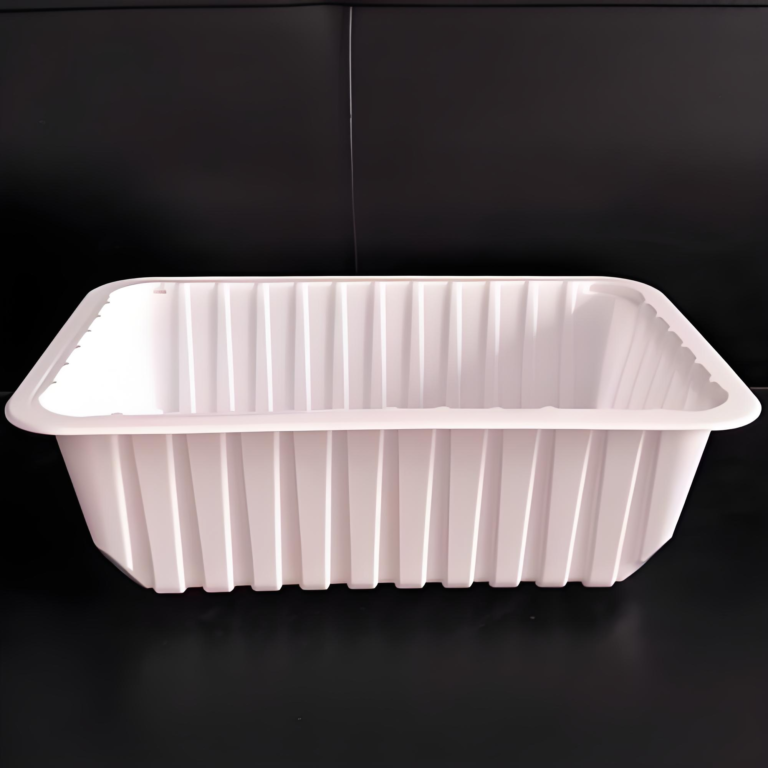
In food packaging thermoforming, it is used to produce trays and containers with consistent wall thickness and strong sealing performance.
In industrial packaging, it is used for durable trays and logistics containers that require high stacking strength and impact resistance.
In medical packaging manufacturing, this process produces sterile trays and protective housings with high dimensional accuracy and reliability.
It is also widely used in consumer packaging production where appearance quality and structural consistency are critical.
Cost Optimization and Production Efficiency
Insert-assisted thermoforming improves material utilization in plastic forming processes by reducing excessive thinning and material waste.
This leads to lower scrap rates in plastic manufacturing and improved cost efficiency in thermoformed product production.
The process enhances cycle stability, allowing more consistent output in high-volume thermoforming production lines.
Reduced rework and improved forming accuracy also help lower overall manufacturing costs while increasing production efficiency.
Why Choose Our Thermoforming Plastic Forming Services
We provide professional plastic thermoforming manufacturing solutions tailored for industrial, packaging, and medical applications.
Our plug-assisted thermoforming process ensures consistent wall thickness, improved deep draw capability, and high structural reliability.
We support a wide range of thermoplastic materials and optimize forming parameters for each project to achieve stable and repeatable production results.
With strong expertise in advanced plastic forming technologies, we deliver scalable and cost efficient thermoforming solutions for global industrial clients.
FAQ: Insert-Assisted Thermoforming (Plug-Assisted Thermoforming)
What does the plug do in plug-assisted thermoforming?
The plug is a mechanical tool that pre-stretches the heated sheet downward into the cavity before vacuum or pressure forming completes the shape. By distributing material into deep draw areas before the vacuum contacts the full surface, the plug prevents excessive thinning in the base corners and improves overall wall thickness uniformity.
What materials are the plugs made from, and does it matter?
Syntactic foam plugs are the most common because they have low thermal conductivity and low surface friction, which allows the sheet to slide over the plug without marking or premature cooling. Aluminum plugs conduct heat away and can cause chilling marks if not properly managed. We select plug material based on sheet material and draw geometry.
How much improvement in wall thickness uniformity does plug assistance provide?
For deep draw containers, plug assistance can reduce wall thickness variation from the 40–50% range without plugs to under 20% with an optimized plug. The improvement depends on the draw ratio, plug shape, sheet temperature, and plug timing.
Is plug-assisted thermoforming suitable for thin-gauge packaging?
Yes. It is widely used for thin-gauge food packaging such as yogurt cups, deep-draw tubs, and medical blisters where uniform wall thickness directly affects structural performance, seal flange integrity, and material efficiency.
Can the plug geometry affect the appearance of the finished part?
Yes. Plug contact area and surface condition can leave visible marks if the temperature differential between plug and sheet is too large. Plug geometry that does not match the mold cavity proportion can cause wrinkles or uneven draw. Plug design is considered part of the tooling scope and is developed alongside the forming mold.
Related products: Pressure Thermoforming, Injection Stretch Blow Molding Service | High-Strength PET Bottle Manufacturing, Thermoplastic Plastic Processing Services (ABS, PLA, and More), Insert Injection Molding (Insert Molding Service), Plastic Fiber Extrusion & Spinning Services for Packaging and Agricultural Applications.
Technical Parameters
| Parameter Category | Technical Specification |
|---|---|
| ------------------------ | ----------------------------------------------------------------------------------- |
| Process Type | Insert-assisted thermoforming / Plug-assisted thermoforming |
| Forming Technology | Vacuum forming or pressure forming with mechanical pre-stretch |
| Material Type | Thermoplastic sheets for industrial forming |
| Forming Capability | Deep draw thermoforming for complex geometries |
| Thickness Control Method | Plug-assisted material distribution control |
| Mold System | Single cavity or multi cavity thermoforming molds |
| Cooling Process | In-mold cooling for dimensional stability |
| Production Mode | Continuous thermoforming production or batch manufacturing |
| Post Processing | Trimming, punching, surface finishing, assembly ready output |
| Quality Control | Wall thickness inspection, dimensional accuracy control, surface quality inspection |
| Automation Level | Semi-automated and fully automated thermoforming production lines |
Samples
Related Manufacturing Capabilities
Pressure Thermoforming
Home/Products/Plastic molding/Thermoforming/Pressure Thermoforming High-Detail Plastic Forming with Vacuum and Air Pressure Technology Pressure thermoforming is an advanced thermoforming process that combines vacuum…
Vacuum Thermoforming
Home/Products/Plastic molding/Thermoforming/Vacuum Thermoforming Vacuum Forming Process for Plastic Sheet Manufacturing Vacuum thermoforming is one of the most widely used thermoforming processes in…
Is this process a fit for your part?
Send your drawing, material, quantity, finish and application requirements for a manufacturing review.