Technical Capability & RFQ
Structural / Reinforced Rotomolding Service | High-Strength Hollow Components
Discuss This PartCapability decision data
Technical fit for Rotational molding
Use this capability summary to decide whether the process fits the part before discussing tooling, lead time or price.
- Best fit
- Large, hollow and seamless parts such as tanks, enclosures and durable low-stress shells.
- Design focus
- Generous radii, material flow into corners, inserts, vents and nominal wall distribution need early attention.
- Material direction
- Powder-grade polyethylene is common; UV, chemical, stiffness and impact needs guide the grade and additives.
- Volume and cost logic
- Lower-pressure tooling can reduce mold cost, while long heating and cooling cycles affect unit economics.
- Inspection focus
- Check wall distribution, internal porosity, cure, warpage, inserts, threads and leak performance.
- Compare against
- Compare with blow molding for higher-volume containers and thermoforming when an open shell or joined assembly is acceptable.
Product Description
Structural or Reinforced Rotomolding is an advanced rotational molding process that incorporates reinforcing fibers or filler materials into the plastic matrix to produce strong, durable hollow components. This technique enhances strength, rigidity, and impact resistance, making it ideal for industrial and heavy-duty applications. As a professional plastic parts manufacturer, we provide custom reinforced rotomolding solutions for machinery housings, transport pallets, protective covers, and other load-bearing hollow structures. Whether you need non-standard plastic molding or small-batch plastic parts customization, our process delivers high-performance, consistent-quality components.
Advantages of Structural / Reinforced Rotomolding
- Enhanced Strength & Rigidity
Fiber or filler reinforcement improves load-bearing capacity and stiffness. - Impact Resistance
Components can withstand mechanical shocks and repeated stress. - Lightweight Hollow Structures
Maintains structural integrity while reducing overall weight. - Durable & Long-Lasting
Resistant to cracking, deformation, and wear in demanding environments. - Flexible Design
Complex geometries and large hollow shapes are achievable without expensive tooling.
Our Reinforced Rotomolding Process
Material Compounding
Plastic resin is blended with reinforcing fibers or fillers to enhance strength and rigidity.
Mold Loading & Rotation
The reinforced material is loaded into the hollow mold, which is rotated biaxially while heated to ensure uniform material distribution.
Cooling & Demolding
The part is cooled under controlled conditions to maintain dimensional stability and surface quality, then removed from the mold.
Inspection & Finishing
Finished components undergo dimensional inspection, mechanical testing, and surface quality verification. Secondary operations such as trimming, machining, or assembly are applied as required.
Common Materials for Reinforced Rotomolding
| Material | Key Benefits | Typical Applications |
|---|---|---|
| Glass Fiber Reinforced PE | High stiffness, impact resistance | Industrial machinery housings, pallets |
| Carbon Fiber Reinforced Plastics | Lightweight, high strength | Protective covers, structural components |
Industry Applications
- Industrial Machinery Housings
Durable, lightweight protective covers and enclosures for machines. - Transport Pallets & Storage Containers
High-strength hollow pallets and industrial transport boxes. - Protective Covers & Guards
Reinforced covers to protect equipment from impact or environmental stress. - Heavy-Duty Hollow Structural Components
Components for industrial applications requiring both rigidity and lightweight design.
Quality Control & Performance Testing
- Impact & Load Testing
Ensures hollow components can withstand mechanical stress and repeated impacts. - Dimensional Verification
Precision inspection to maintain consistency and ensure proper assembly fit. - Surface Quality Checks
Eliminates defects such as voids, warping, or uneven fiber distribution. - Material Consistency
Fiber or filler content is monitored to maintain structural performance across batches.
Cost Optimization & Production Efficiency
- Lightweight Design
Reduces raw material costs and transportation expenses. - Integrated Reinforcement
Eliminates the need for additional secondary reinforcement or assembly. - Scalable Production
Supports prototype development, small-batch orders, and medium-volume manufacturing. - Complex Geometries Without High Tooling Costs
Rotomolding enables large, hollow parts with minimal mold expenses.
Why Choose Us
As a trusted plastic parts manufacturer, we specialize in structural and reinforced rotomolding, non-standard plastic molding, and small-batch plastic parts customization. From material compounding and mold design to precision manufacturing and quality inspection, we provide complete solutions for high-strength hollow plastic components.
Send us your drawings or specifications today for a free engineering evaluation and custom reinforced rotomolding consultation.
FAQ: Structural / Reinforced Rotomolding Service
How is fiber reinforcement incorporated into rotomolded parts?
Reinforcement in rotomolding is typically achieved by including glass fiber rovings, woven fabric, or chopped mat as an inner layer that bonds to the molten plastic during the cure cycle. Alternatively, structural foam cores can be added after an initial shell has formed.
What load improvements can reinforcement provide to rotomolded parts?
Wall panel stiffness and top-load compressive strength are the most significant improvements. For large tanks and enclosures where deflection under load is a design concern, reinforcement allows thinner walls with equivalent stiffness, reducing part weight and material cost.
In which industries are reinforced rotomolded parts most commonly used?
Industrial chemical storage tanks with structural load requirements, agricultural sprayer tanks, military and utility vehicle bodies, and marine floats requiring impact and structural resistance are primary applications.
How is quality validated for structural rotomolded components?
Wall thickness mapping by destructive sectioning or non-destructive ultrasonic testing, hydrostatic pressure testing for tanks, top-load compression testing, and UV and chemical exposure testing are standard validation methods.
Can reinforced rotomolded parts be repaired if damaged in service?
LLDPE-based rotomolded parts can be repaired by plastic welding, which joins new material to the existing shell. Reinforced zones are more difficult to repair because the fiber-resin bond cannot be easily re-formed. Repair feasibility depends on the damage location and structural integrity requirements.
Related products: Fiber Reinforced Compression Molding Service | High-Strength Structural Components, Rotational Molding Services for Large Hollow Plastic Products, Standard Compression Molding Service | High-Performance Thermoset Components, Stretch Blow Molding Service | High-Strength Plastic Container Manufacturing, Plastic Surface Finishing & Assembly Services, Injection Stretch Blow Molding Service | High-Strength PET Bottle Manufacturing.
Technical Parameters
| Parameter | Typical Value / Range |
|---|---|
| ---------------------- | --------------------------------------------------------- |
| Process Type | Structural / Reinforced Rotomolding |
| Reinforcement Type | Glass Fiber, Carbon Fiber, Mineral Fillers |
| Supported Materials | GF-PE (Glass Fiber Reinforced PE), CF-Reinforced Plastics |
| Maximum Part Size | Up to 3000 mm x 1500 mm x 1200 mm |
| Wall Thickness | 3 mm – 25 mm |
| Dimensional Tolerance | ±0.5 mm – ±2.0 mm |
| Surface Finish | Smooth / Textured / Custom Patterns |
| Mechanical Performance | High impact & load resistance |
| Production Speed | Medium-volume, batch-dependent |
| MOQ | Prototype to medium production batch |
| Secondary Services | Trimming, Machining, Assembly, Drilling |
Samples
Related Manufacturing Capabilities
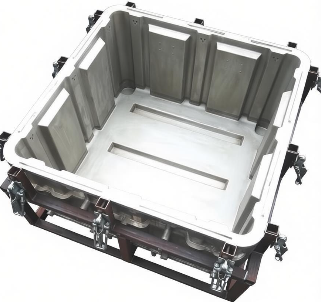
Custom / Specialty Rotomolding Service | Complex & Multi-Functional Hollow Components
Home/Products/rotational molding/Custom / Specialty Rotomolding Service | Complex & Multi-Functional Hollow Components Custom or Specialty Rotomolding is a flexible plastic manufacturing process…
Is this process a fit for your part?
Send your drawing, material, quantity, finish and application requirements for a manufacturing review.