
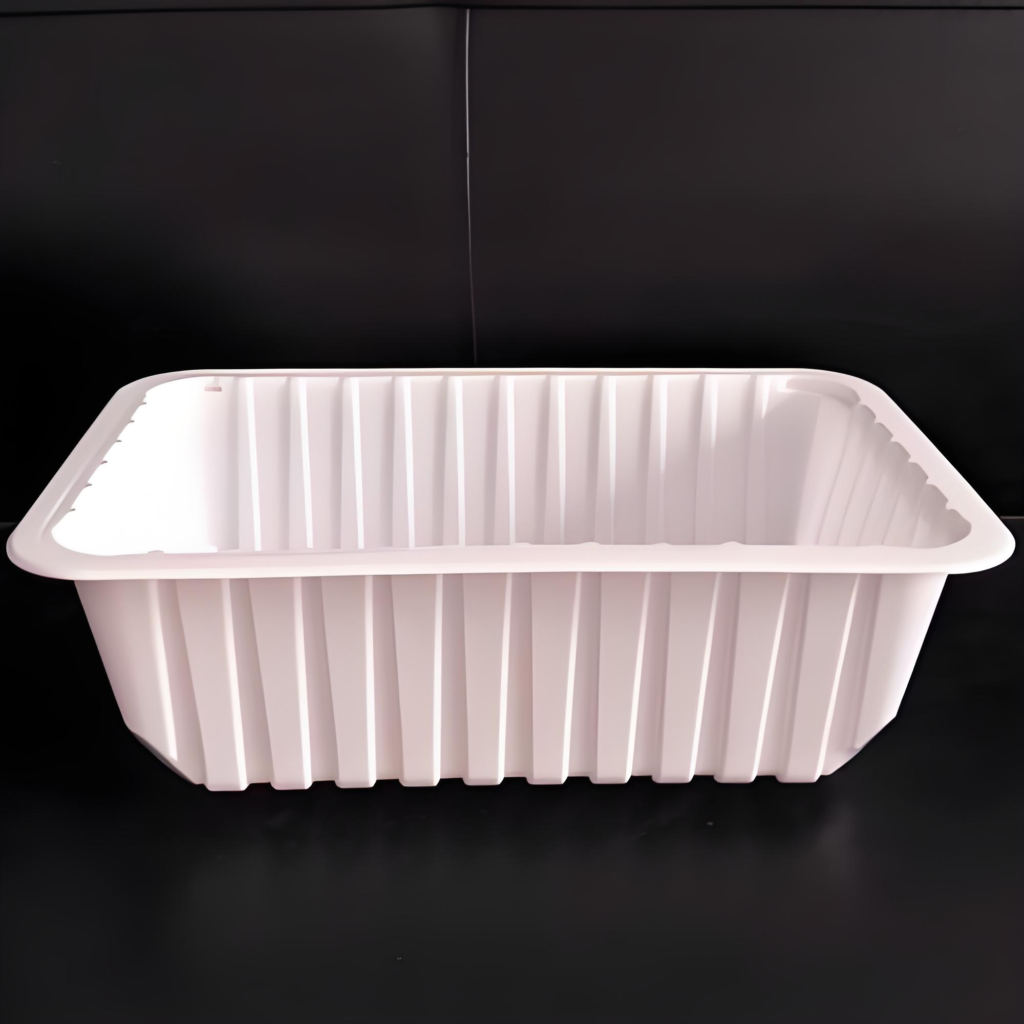
Technical Capability & RFQ
Vacuum Thermoforming
Discuss This PartCapability decision data
Technical fit for Vacuum thermoforming
Use this capability summary to decide whether the process fits the part before discussing tooling, lead time or price.
- Best fit
- Open trays, covers, packaging and large lightweight shells made from thermoplastic sheet.
- Design focus
- Draft, draw ratio, corner radii, plug assistance, trim allowance and wall thinning limit the geometry.
- Material direction
- ABS, HIPS, PETG, PET, PVC, acrylic, PC, HDPE and PP are considered according to forming and service needs.
- Volume and cost logic
- Relatively simple tooling is attractive for prototypes through medium volume; sheet and trimming affect part cost.
- Inspection focus
- Check thickness distribution, webbing, surface marks, trim position, flange distortion and fit to mating parts.
- Compare against
- Compare with pressure forming for sharper detail and injection molding for high-volume, feature-rich parts.
Product Description
Vacuum Forming Process for Plastic Sheet Manufacturing
Vacuum thermoforming is one of the most widely used thermoforming processes in plastic manufacturing. In this process, a heated plastic sheet is softened and formed over a mold surface using vacuum suction pressure.
This manufacturing method is highly cost-effective and ideal for medium and small batch production of lightweight plastic products with simple to moderately complex shapes.
Key Features
- Low mold tooling cost
- Fast product development cycle
- Suitable for small and medium production volumes
- Efficient production process
- Lightweight product structures
- Good surface appearance
- Supports large-size plastic components
Manufacturing Process
- Plastic sheet is heated until softened
- Heated sheet is positioned over the mold
- Vacuum pressure pulls the sheet tightly onto the mold surface
- Material cools and retains final shape
- Formed part is trimmed and finished
This process allows rapid manufacturing with relatively simple tooling systems.
Suitable Materials
Vacuum thermoforming supports a variety of thermoplastic sheets:
- PET
- PVC
- PS (Polystyrene)
- PP (Polypropylene)
- ABS
- Acrylic (PMMA)
- HIPS (High Impact Polystyrene)
Material selection depends on transparency, strength, food safety, and application requirements.
Applications
Vacuum thermoforming is widely used in packaging and display industries:
- Packaging trays
- Disposable food containers
- Blister packaging
- Product display trays
- Medical packaging
- Protective plastic covers
- Retail packaging inserts
Cost Optimization & Efficiency
Vacuum thermoforming provides major production advantages:
- Lower mold cost compared to injection molding
- Faster tooling and product launch time
- Reduced investment for short-run production
- Efficient for large-size thin-wall products
- Lower material waste with optimized sheet layout
- Flexible design modifications for custom projects
Why Choose Us
We provide professional vacuum thermoforming solutions with stable production capability:
- Custom mold design and fabrication
- Fast prototype and sampling support
- Precision trimming and finishing
- Food-grade and industrial material processing
- Stable quality control system
- Flexible production volume capability
- Experience in packaging and industrial applications
We help customers produce lightweight, cost-effective thermoformed plastic products with reliable quality and fast turnaround.
FAQ: Vacuum Thermoforming
How does vacuum thermoforming work compared to pressure thermoforming?
In vacuum thermoforming, atmospheric pressure on the outer surface and vacuum drawn through the mold are the only forces shaping the heated sheet against the mold. Pressure thermoforming adds compressed air pressure from above to assist forming. Vacuum thermoforming is simpler and lower tooling cost but has limitations on deep draws and sharp detail.
What draw depth is achievable with vacuum thermoforming?
Vacuum thermoforming works well for draw ratios (depth divided by smallest opening dimension) up to approximately 0.5:1. Beyond this, wall thinning in the corners and sides becomes pronounced. Deep draw or complex detail typically requires pressure forming or plug assistance.
What mold materials are used for vacuum thermoforming tooling?
Aluminum is most common for production tooling due to its thermal conductivity and surface finishability. Epoxy or composite molds are used for prototyping or short runs. Mold material affects surface temperature uniformity and therefore part quality consistency.
Is vacuum thermoforming suitable for food packaging applications?
Yes, when the correct food-grade materials are used—such as PETG, HIPS, PP, or food-grade HDPE—vacuum thermoforming is widely used for trays, clamshells, blister packs, and containers. Material compliance documentation should be discussed at project start.
How does sheet thickness affect vacuum thermoforming outcomes?
Thicker sheets provide more structural rigidity but require more heat time and forming force, and may not achieve the same detail as thinner sheets. Thinner sheets form more quickly and conform to detail better but may lack stiffness in the finished part. Material selection and thickness are reviewed together with part geometry and application load requirements.
Related products: Thermoforming & Vacuum Forming Services for Packaging and Industrial Applications, Insert-Assisted Thermoforming (Plug-Assisted Thermoforming), Insert Injection Molding (Insert Molding Service), Hot Runner Injection Molding, Micro Injection Molding (Micro Molding Service).
Technical Parameters
| Item | Specification |
|---|---|
| ---------------------------- | ----------------------------------------- |
| **Process Type** | Vacuum Thermoforming |
| **Forming Method** | Vacuum suction forming |
| **Material Thickness Range** | 0.2 – 8 mm |
| **Suitable Materials** | PET, PVC, PP, ABS, PS, PMMA |
| **Mold Type** | Aluminum / composite / resin molds |
| **Production Volume** | Prototype to medium-volume production |
| **Part Size Capability** | Small to large plastic components |
| **Cycle Time** | 15 – 90 seconds |
| **Surface Finish** | Glossy / matte / textured |
| **Post Processing** | CNC trimming, cutting, drilling available |
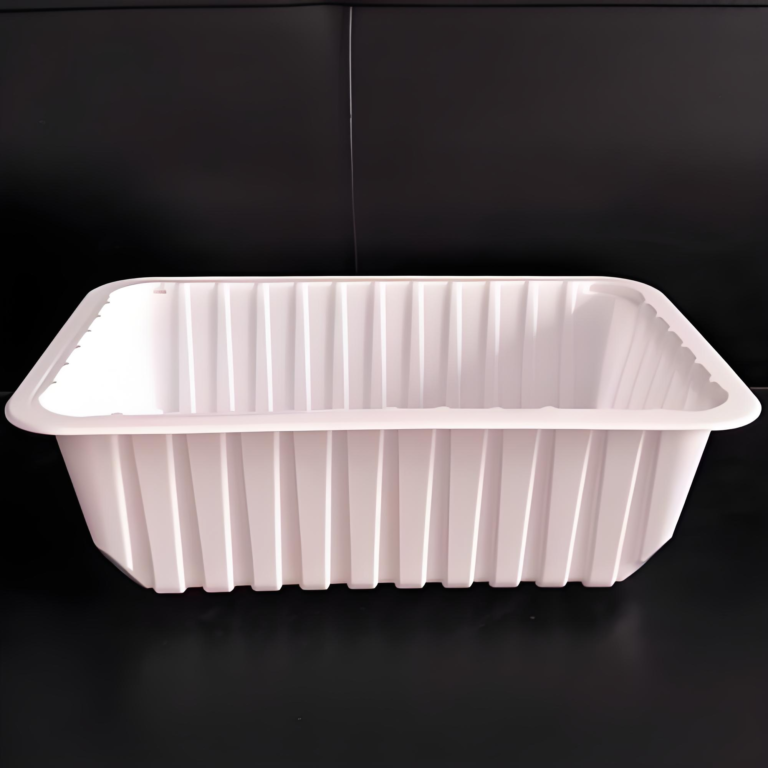
Samples
Related Manufacturing Capabilities
Insert-Assisted Thermoforming (Plug-Assisted Thermoforming)
Home/Products/Plastic molding/Thermoforming/Insert-Assisted Thermoforming (Plug-Assisted Thermoforming) Insert-assisted thermoforming, also known as plug-assisted thermoforming, is an advanced plastic thermoforming process designed to improve material…
Pressure Thermoforming
Home/Products/Plastic molding/Thermoforming/Pressure Thermoforming High-Detail Plastic Forming with Vacuum and Air Pressure Technology Pressure thermoforming is an advanced thermoforming process that combines vacuum…
Is this process a fit for your part?
Send your drawing, material, quantity, finish and application requirements for a manufacturing review.